
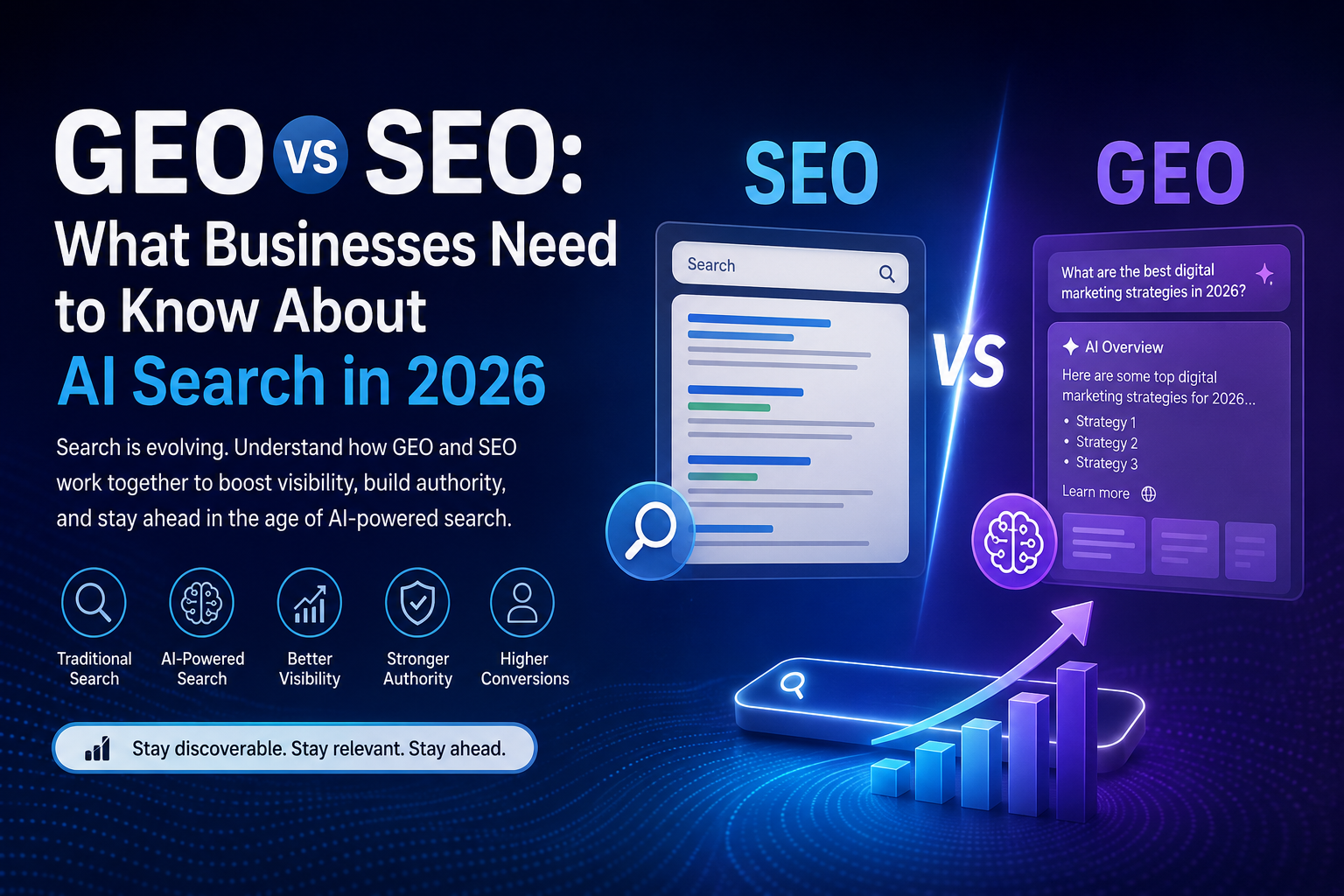
Search is changing faster than ever. For years, businesses focused on SEO to improve their rankings on Google, attract organic traffic, and generate leads. But the rise of AI-powered search experiences has introduced a new way for people to discover information, products, and brands.
Today, users may ask detailed questions and receive AI-generated answers with links to supporting websites. Google’s AI Overviews and AI Mode are examples of this evolving search experience. As a result, businesses are increasingly hearing terms such as GEO (Generative Engine Optimization), AEO (Answer Engine Optimization), and AI Search Optimization.
But does GEO replace SEO? The answer is no. In 2026, businesses should understand how GEO and SEO work together to build stronger visibility across traditional and AI-powered search.
SEO, or Search Engine Optimization, is the process of improving a website so that search engines can crawl, understand, index, and rank its content.
Traditional SEO focuses on areas such as:
• Keyword research and search intent
• On-page optimization
• Technical SEO
• Website structure and internal linking
• High-quality content
• Backlinks and authority
• Page experience
• Local SEO
• Image and video optimization
These fundamentals remain important even as search becomes more AI-driven. Google’s current documentation specifically states that the foundational best practices of SEO continue to apply to AI features such as AI Overviews and AI Mode.
GEO stands for Generative Engine Optimization. It generally refers to efforts aimed at improving a brand’s chances of being discovered, referenced, or linked within AI-generated search experiences.
Instead of focusing only on the question, “How can I rank on Google?”, GEO expands the thinking to questions such as:
“How can my brand become a useful and trustworthy source when AI systems generate an answer?”
For example, someone may ask an AI-powered search engine:
“What are the best digital marketing agencies for e-commerce businesses in India?”
Instead of receiving only a traditional list of blue links, the user may receive an AI-generated response containing recommendations and supporting links.
This creates a new visibility opportunity for businesses.
The biggest difference is the search environment and the way visibility is measured.
SEO primarily focuses on:
Improving visibility in conventional search results and attracting organic visitors.
GEO focuses on:
Improving the likelihood that useful brand information is surfaced or referenced within generative AI experiences.
However, these strategies are not competitors.
A strong GEO strategy still depends heavily on the fundamentals of SEO. Google explains that its generative AI search experiences rely on information retrieved from its Search index, meaning technical accessibility, indexing, quality, relevance, and helpful content remain important.
One of the biggest misconceptions about GEO is that businesses need to abandon traditional SEO.
They don't.
Google's 2026 guidance makes it clear that SEO remains relevant for generative AI search. Websites still need to be crawlable and indexable, provide valuable content, use strong internal linking, deliver a good page experience, and ensure that important information is available in text.
In other words, GEO should be viewed as an evolution of search visibility rather than a complete replacement for SEO.
1. Create Unique, Helpful Content
AI search makes generic content less valuable. Businesses should publish content that demonstrates genuine expertise, experience, original insights, examples, data, and solutions.
Google's latest generative-AI guidance emphasizes creating unique, valuable, non-commodity content that provides real value to users.
2. Answer Specific Customer Questions
AI-powered search is designed to handle longer and more complex questions.
Instead of creating content only around short keywords, businesses should answer questions their customers actually ask.
For example:
• How much does digital marketing cost?
• Which SEO strategy is best for an e-commerce business?
• How can a local business generate leads online?
• What is the difference between SEO and PPC?
This approach can help a website become a useful information source.
3. Build Strong Brand Authority
AI search is not simply about inserting keywords into content. Businesses should establish credibility across their website and broader digital presence.
Clear company information, author expertise, customer reviews, industry mentions, useful resources, and consistent brand information can all contribute to a stronger online presence.
4. Strengthen Technical SEO
A beautiful website is not enough if search engines cannot properly access and understand it.
Businesses should regularly review:
• Robots.txt
• XML sitemaps
• Indexing
• Internal links
• Page speed
• Mobile usability
• Structured data
• Canonical URLs
• Website architecture
Google confirms that pages need to meet the normal technical requirements for Search to be eligible as supporting links in AI Overviews or AI Mode.
5. Think Beyond Text
AI-powered search is increasingly multimodal. Users may search using images, videos, or combinations of different formats.
Businesses should therefore consider high-quality:
• Images
• Videos
• Product information
• Infographics
• Location information
• Business Profile data
Google specifically recommends supporting textual content with high-quality images and videos where appropriate.
Traditional SEO reporting often focuses on rankings, impressions, clicks, organic traffic, and conversions.
AI search introduces additional questions:
• Is the brand appearing in AI-generated responses?
• Which topics generate AI visibility?
• Which pages are being referenced?
• Are AI-driven visitors converting?
• Is brand visibility increasing across generative search experiences?
Google introduced Search Generative AI performance reports in Search Console in June 2026, providing dedicated visibility data for generative AI features such as AI Overviews and AI Mode, initially rolling out to a subset of websites.
This means businesses can increasingly think beyond traditional rankings and evaluate the broader value of search visibility.
The smartest approach is not choosing one over the other.
Businesses should build a strong SEO foundation and then create content and brand strategies that are suitable for modern AI search experiences.
Think of it this way:
SEO helps search engines discover, understand, and rank your website.
GEO focuses on improving your visibility within generative AI experiences.
Both ultimately depend on the same core principles: useful information, technical accessibility, relevance, authority, and a strong user experience.
AI is changing how people search, but it has not made SEO irrelevant. Instead, search is becoming more conversational, contextual, multimodal, and exploratory.
Businesses that continue creating valuable content, maintaining technically sound websites, building brand authority, and understanding customer intent will be better positioned for both traditional and AI-powered search.
At Substance Digital, businesses can take a future-ready approach by combining SEO, content marketing, performance marketing, website optimization, and emerging AI-search strategies. The goal is not simply to chase rankings it is to make your brand discoverable wherever your potential customers are searching.
In 2026, the question is no longer only “How do we rank on Google?” It is also “How do we become the brand people—and AI-powered search experiences find useful?”
That is where the future of search visibility begins.
Let's Connect
Don't wait until tomorrow. Talk to one of our consultants today and learn how to start leveraging your business.